.png)

Denzlee Knudsen
.png)
At Pulse For Good, we believe that listening is one of the most powerful tools any organization can use to grow and improve. However, collecting feedback is the easy part. It’s understanding what the feedback means and how to interpret that information that takes time and effort. That’s where our artificial intelligence system comes in.
We’ve built our own AI to help transform raw feedback into clear, meaningful insights. Instead of doing the tedious task of sifting through hundreds of survey responses manually, our AI does the heavy lifting for you. It analyses text, detects emotions, identifies trends and turns everything into easy-to-read metrics.
Our AI automatically categorizes and summarizes data, filtering out spam or irrelevant responses so you can focus on what truly matters. It highlights real trends and even compares new feedback to previous results, helping you track progress over time.
All of this information shows up right on your dashboard where you can view feedback data as both numerical scores and emotional sentiment. With just a glance, you’ll know how your organization is performing and, more importantly, how your clients feel about their experiences.
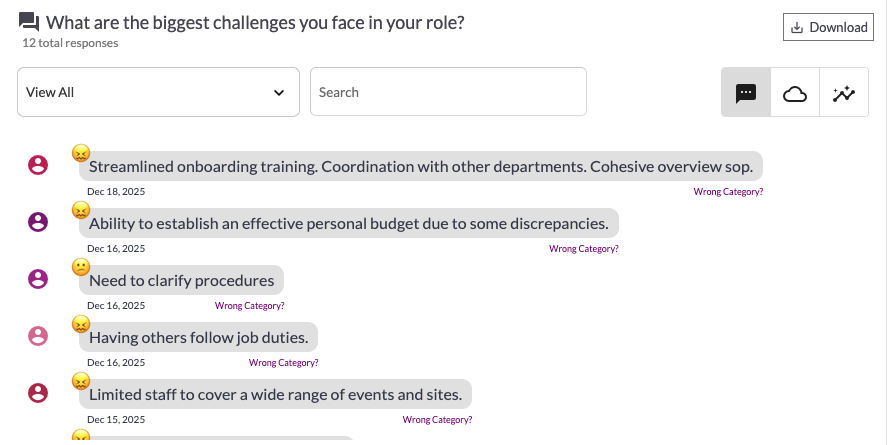
One of the most unique aspects of our system is its ability to detect emotion in survey responses. The AI identifies patterns in language and tone. Categorizing feedback by how people are feeling, whether that’s happy, frustrated, grateful, etc.
These emotions are displayed in the Top Emotion bank, showing the most common feelings your clients express. And because AI is always learning you can manually recategorize any emotion that doesn’t quite match.
Once emotions are identified, our AI translates that sentiment into clear, measurable scores that help you track overall satisfaction and engagement.
The Customer Satisfaction (CSAT) score represents how satisfied customers are with your services. It analyzes those sentiments to determine a percentage of their satisfaction. The CSAT score is considered good above 70%. A score below 50% means there is high dissatisfaction.
The Voice of Customer Index (VOCI) combines the sentiment with time each respondent took in engaging with the survey to determine the accuracy of the responses. A score above 60 means the information is more likely to be honest. Under 40 means there needs to be significant changes happening.
The Total Brand Sentiment (TBS) is trained to recognize how customers and clients perceive the organization’s
brand. When the TBS is put into a numerical score, 60 means there is a positive brand perception. 40 and below means there is room for improvement.
The Net Promoter Score (NPS) interprets the responses from the level of satisfaction to how loyal the customers are to the brand. 30 and above in score means the clients will be more likely to recommend the services to someone else. Anything below a score of -10 indicates more detractors than promoters.
Pulse For Good’s AI system turns complex, unstructured data into insights you can actually use. It takes the guesswork out of understanding your customers and helps you close the feedback loop faster and more effectively.
By combining emotional intelligence with clear, data-driven metrics, we’re making it easier than ever to listen, learn and improve.
Learn how our AI can impact your organization by booking a demo with us on our website at pulseforgood.com.
.png)